
Radians to Degrees Converter — Trigonometry & Unit Circle Calculations
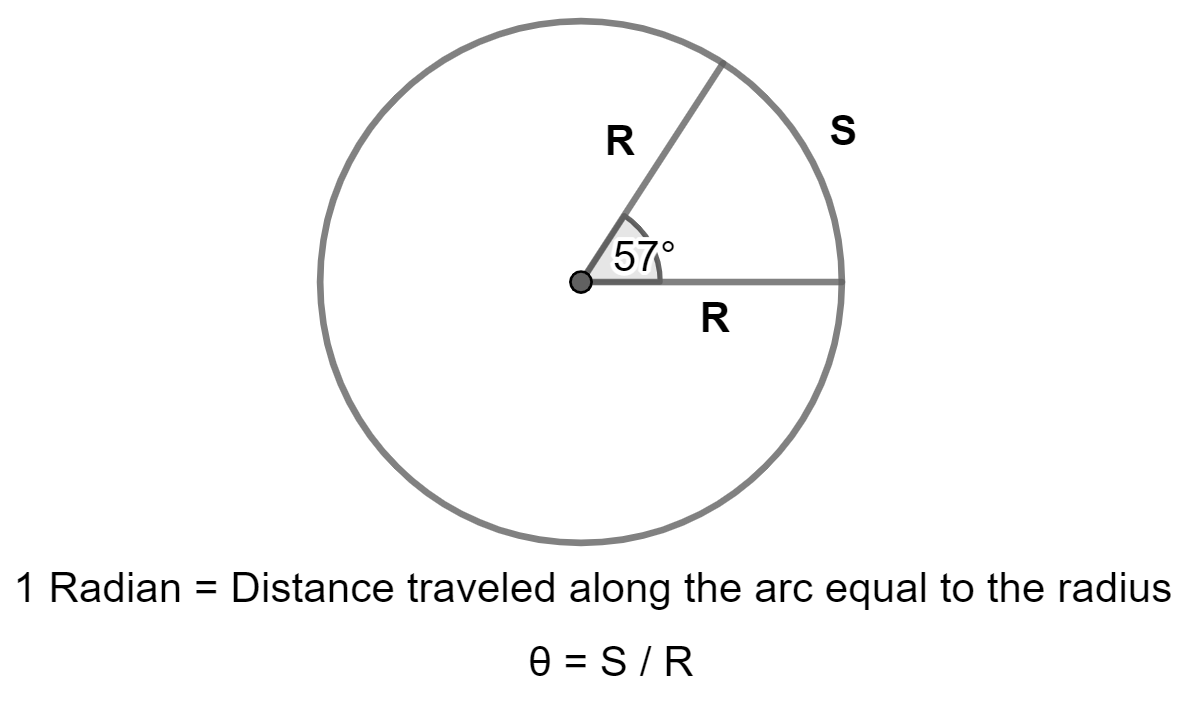
Converting radians to degrees bridges pure calculus and physical angle comprehension. While mathematical derivatives, sinusoidal oscillation equations ($omega = 2pi f$), and orbital physics calculate in natural radians along the unit circle ($2pitext{ rad} = 360^circ$), engineers and technicians visualize angles on 360-degree protractors. Multiplying radians by $180/pi$ (approximately 57.2958) converts the angle to degrees.
Angle Studio
Conversion Table
| Radians | Degrees |
|---|---|
| 0.5 rad | 28.65° |
| 1 rad | 57.30° |
| 1.5 rad | 85.94° |
| 2 rad | 114.59° |
| 3.14159 rad | 180.00° |
Overview & Capabilities
Converting radians to degrees bridges pure calculus and physical angle comprehension. While mathematical derivatives, sinusoidal oscillation equations ($omega = 2pi f$), and orbital physics calculate in natural radians along the unit circle ($2pitext{ rad} = 360^circ$), engineers and technicians visualize angles on 360-degree protractors. Multiplying radians by $180/pi$ (approximately 57.2958) converts the angle to degrees.
How to Use
Key Features
Common Use Cases
Tips & Best Practices
Related Tools
Degrees to Radians Converter
Convert degrees to radians (deg to rad) instantly with exact π notation. Calculate angles for JavaScript Math functions, robotic arm servos, and navigation.

Pixels to REM Converter
Convert pixels to REM units (px to rem) instantly with custom base font sizing. Perfect for responsive CSS stylesheets, Figma tokens, and accessibility.

Kilowatts to Horsepower Converter
Convert kilowatts to horsepower (kW to HP) instantly. Calculate electric vehicle (EV) motor outputs, industrial pump ratings, and generator capacity.
Power Converter
Universal power converter for Watts (W), Kilowatts (kW), Horsepower (HP), BTU/hr, and Tons of Refrigeration. Calculate HVAC AC cooling loads and electrical capacity.
Frequently Asked Questions
Q What is 1 radian in degrees?
1 radian equals approximately 57.2958 degrees.
Q What is π (pi) radians in degrees?
π radians equals exactly 180 degrees.
Q What is π/2 radians in degrees?
π/2 radians (approx 1.5708 rad) equals exactly 90 degrees.
Q What is 2π radians in degrees?
2π radians equals exactly 360 degrees (one full rotation).