
Binary to Text & Text to Binary Studio
Welcome to the Binary Encoding Studio, type binary digits or plain text to instantly decode and translate.
Modifying any field automatically synchronizes the rest in real-time. Spaces are automatically handled.
Equivalence outcomes
Step-by-Step Byte Mappings
Walkthrough of characters to their binary representations (up to first 5)
Premium Study Presets & Benchmarks
Click any preset to instantly load and visualize its binary representation
ASCII Reference Table
Standard 8-bit reference codes for alphabetical characters
| Character | Decimal Code | Hex Equivalent | Binary Octet (8-bit) | Weight Classification |
|---|---|---|---|---|
| A | 65 | 0x41 | 01000001 | Standard Uppercase |
| B | 66 | 0x42 | 01000010 | Standard Uppercase |
| Z | 90 | 0x5A | 01011010 | Uppercase Boundary |
| a | 97 | 0x61 | 01100001 | Standard Lowercase |
| z | 122 | 0x7A | 01111010 | Lowercase Boundary |
| Space | 32 | 0x20 | 00100000 | Control Separator |
Understanding Binary-to-Text translation systems
Learn the digital hardware pathways, character charts, and memory architectures that enable computers to read strings.
The 8-Bit Byte (Octet) Rule
Every character in basic digital computing corresponds to an 8-bit byte. 8 bits allow up to 256 unique mappings representing characters, numbers, and system control codes.
1 Byte = 8 Bits (allowing values 0 to 255). ASCII vs Modern UTF-8 Encodings
ASCII was created in 1963 for English letters. Modern UTF-8 expands this by using variable width bytes (1 to 4 bytes) to map globally unified emojis and mathematical symbols.
High Performance Offline Translation
Your security is fully guaranteed. All conversion and parsing takes place offline inside your browser window. Zero data packets are dispatched to external cloud APIs.
JWT, Base64, and URL Encoding Explained
Demystify data encoding formats. Learn how JSON Web Tokens work, when to use Base64, URL encoding, Hex, Binary, and Unicode standards to transmit and structure backend data safely.
Read the Complete Guide➔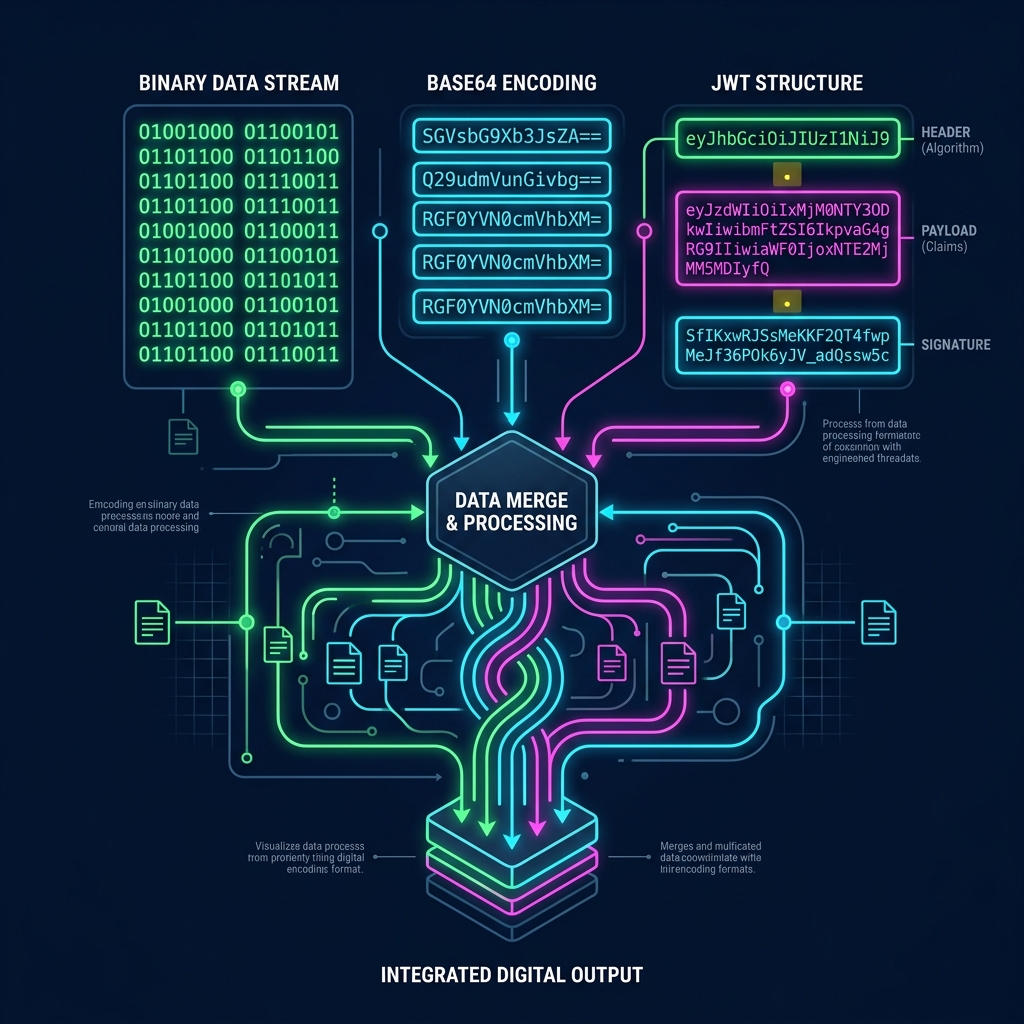
Overview & Capabilities
Translate binary code (0s and 1s) into readable English text and convert text into binary bitstrings with our Binary Text Studio! Supporting 8-bit ASCII and UTF-8 multi-byte Unicode characters, this tool provides character-by-character binary breakdowns, custom byte delimiters, and ASCII code point references.
How to Use
01001000 01101001) or type plain English text into the editor.Key Features
Common Use Cases
Tips & Best Practices
Algorithm Comparison & Best Use Cases
ASCII Encoding
The American Standard Code for Information Interchange. It maps 128 characters to unique 7-bit binary patterns (modernly used in 8-bit blocks).
Example: "Hello" starts with 01001000 (H).
UTF-8 / Unicode
The universal standard. It is backwards compatible with ASCII but can represent over a million characters, including every language and emoji.
Example: A single emoji can take up to 4 bytes (32 bits).
Common Binary Samples
- 01000001: 'A'
- 01100001: 'a'
- 00110000: '0'
- 00100000: 'Space'
- 01001000 01101001: 'Hi'
Related Tools

Text to Hex Converter
Convert text strings to Hexadecimal byte arrays and decode hex dumps online. Inspect memory buffers, 16-byte columnar views, and UTF-8 code points. Free.
Binary to Decimal Converter
Convert binary bitstrings to base-10 integers and decimal to binary. Step-by-step 2^n positional weights, signed two's complement, and Horner's polynomial rule. Free.

Hex to Binary Converter
Convert Hexadecimal (Base-16) to Binary (Base-2) and binary to hex online. 4-bit nibble lookup tables, byte spacing, and bitwise verification. Free.

Base64 Encoder & Decoder Online
Encode and decode Base64 strings, UTF-8 text, and binary files online. Supports standard RFC 4648, URL-Safe Base64URL, and image Data URIs. 100% Free.

All-in-One Text Encoder & Decoder
Convert text across Base64, Hexadecimal, Binary, URL percent-encoding, HTML entities, and Rot13 concurrently in real time. 100% Free & Private.
Frequently Asked Questions
Q How does binary code translate into readable English characters?
Each character is mapped to a numeric code in the ASCII / UTF-8 character table (e.g. capital 'A' is 65). The computer stores 65 as an 8-bit binary byte: `01000001`.
Q What is the binary representation of 'Hello' in 8-bit ASCII?
`01001000 01100101 01101100 01101100 01101111` (H = 01001000, e = 01100101, l = 01101100, l = 01101100, o = 01101111).
Q How does the tool handle emojis and non-English characters in binary?
The tool converts characters into UTF-8 byte arrays using standard `TextEncoder`, converting multi-byte characters (such as emojis which use 4 bytes) into consecutive 8-bit binary blocks.