
All-in-One Text Encoder & Transformation Studio
Welcome to the Universal Digital Encoder. Real-time, bidirectional encoding & decoding across UTF, Base64, Hex, BCD, URL, and Binary streams.
Symmetrical Domain Presets
Click any quick-load preset to instantly populate the digital workspace
Binary Stream (Base-2)
Base-2 representation of character byte values
Hexadecimal (Base-16)
Compact hexadecimal representation of characters
Base64 (RFC 4648)
Base64 binary-to-text encoding standard
UTF-8 Hexadecimal Mappings
Variable-width character bytes represented in base-16
UTF-16 Hexadecimal Mappings
Double-byte character encoding stream in base-16
UTF-32 Hexadecimal Mappings
Fixed-width 32-bit character representations
Octal Stream (Base-8)
Base-8 positional notation character codes
Decimal Space-Separated (Base-10)
Standard integer character code mappings
Binary Coded Decimal (BCD)
Four-bit binary conversion for each individual decimal digit
URL Percent-Encoded (RFC 3986)
Percent encoded safe format for web transmission
Developer Exports
Generate comprehensive reports containing all encoding translations
ASCII / Character Reference Mappings
Standard binary and hexadecimal representation benchmarks
| Char | Decimal | Hexadecimal | Octal | Binary (8-bit) | Base64 |
|---|---|---|---|---|---|
| A | 65 | 0x41 | 101 | 01000001 | QQ== |
| B | 66 | 0x42 | 102 | 01000010 | Qg== |
| C | 67 | 0x43 | 103 | 01000011 | Qw== |
| D | 68 | 0x44 | 104 | 01000100 | RA== |
| E | 69 | 0x45 | 105 | 01000101 | RQ== |
| 0 | 48 | 0x30 | 060 | 00110000 | MA== |
| 1 | 49 | 0x31 | 061 | 00110001 | MQ== |
| ! | 33 | 0x21 | 041 | 00100001 | IQ== |
| @ | 64 | 0x40 | 100 | 01000000 | QA== |
| # | 35 | 0x23 | 043 | 00100011 | Iw== |
Exploring Symmetrical Encoding Architecture
A complete reference guide to digital character standard conversions, byte widths, and processing models.
What is Multi-Format Encoding?
Encoding converts raw letters into specific byte streams for computers. Standard formats like Hex or Binary let you see exact memory patterns, while URL percent-encoding ensures web safety, and Base64 wraps binary blocks safely within mail or API payloads.
Understanding UTF-8, 16, and 32
UTF-8 uses variable 1-to-4 byte formats for broad compatibility. UTF-16 uses 2-or-4 byte chunks (favored by Java/Windows environments), and UTF-32 is a fixed 4-byte standard displaying direct numeric code-points. Each maps characters differently in memory.
BCD and Industrial Mappings
Binary Coded Decimal (BCD) maps each separate decimal digit into its individual 4-bit binary representation. Highly valued in avionics, physics hardware, and financial systems, it prevents rounding mismatches inherent in binary float math.
25 translates to BCD 0010 0101. JWT, Base64, and URL Encoding Explained
Demystify data encoding formats. Learn how JSON Web Tokens work, when to use Base64, URL encoding, Hex, Binary, and Unicode standards to transmit and structure backend data safely.
Read the Complete Guide➔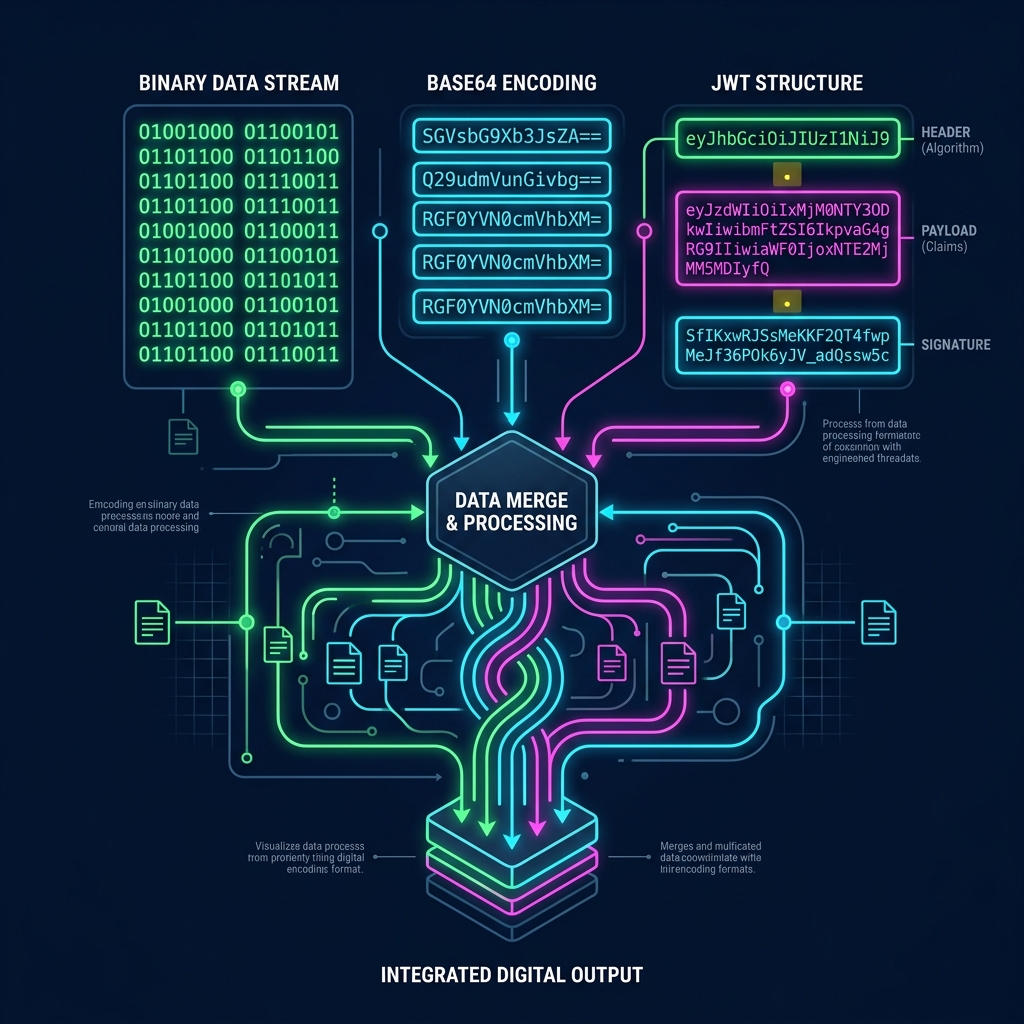
Overview & Capabilities
Encode and decode text across multiple developer formats simultaneously with our All-in-One Text Encoder! Type or paste any string to see real-time conversions into Base64, Hexadecimal, Binary (Base-2), URL Percent-Encoding, HTML Entities, Decimal ASCII, and ROT13 ciphers side-by-side.
How to Use
Key Features
&, <) and numeric entities (&).Common Use Cases
Tips & Best Practices
Related Tools

Base64 Encoder & Decoder Online
Encode and decode Base64 strings, UTF-8 text, and binary files online. Supports standard RFC 4648, URL-Safe Base64URL, and image Data URIs. 100% Free.

Text to Hex Converter
Convert text strings to Hexadecimal byte arrays and decode hex dumps online. Inspect memory buffers, 16-byte columnar views, and UTF-8 code points. Free.

Binary to Text Converter
Translate binary code (01100001) to readable text and text to binary bitstrings online. Supports 8-bit ASCII, UTF-8 Unicode, and ASCII lookup tables. Free.

URL Encoder & Decoder Online
Encode and decode URLs, URI components, and query parameters online. Features RFC 3986 percent-encoding and UTF-8 special character handling. 100% Free.

Case Converter Online
Convert text case online: UPPERCASE, lowercase, Title Case, camelCase, snake_case, kebab-case, PascalCase, and Sentence case. 100% Free & Private.
Frequently Asked Questions
Q How does the multi-format encoder work in real time?
As you type, the engine captures character code points and converts them through parallel transformation pipelines (Base64, Hex, Binary, HTML, URL) in sub-milliseconds.
Q When should I use HTML Entity encoding vs URL encoding?
Use HTML Entity encoding (`<div>`) when displaying raw code in web pages to prevent XSS. Use URL encoding (`%20`, `%26`) when passing parameters inside web links.
Q What is ROT13 encoding?
ROT13 ('rotate by 13 places') is a simple substitution cipher that replaces a letter with the 13th letter after it in the alphabet. Because the English alphabet has 26 letters, applying ROT13 twice restores the original text.